Scaling Organic Search for a Regulated Ecommerce Brand: A 200% Traffic Growth Case Study
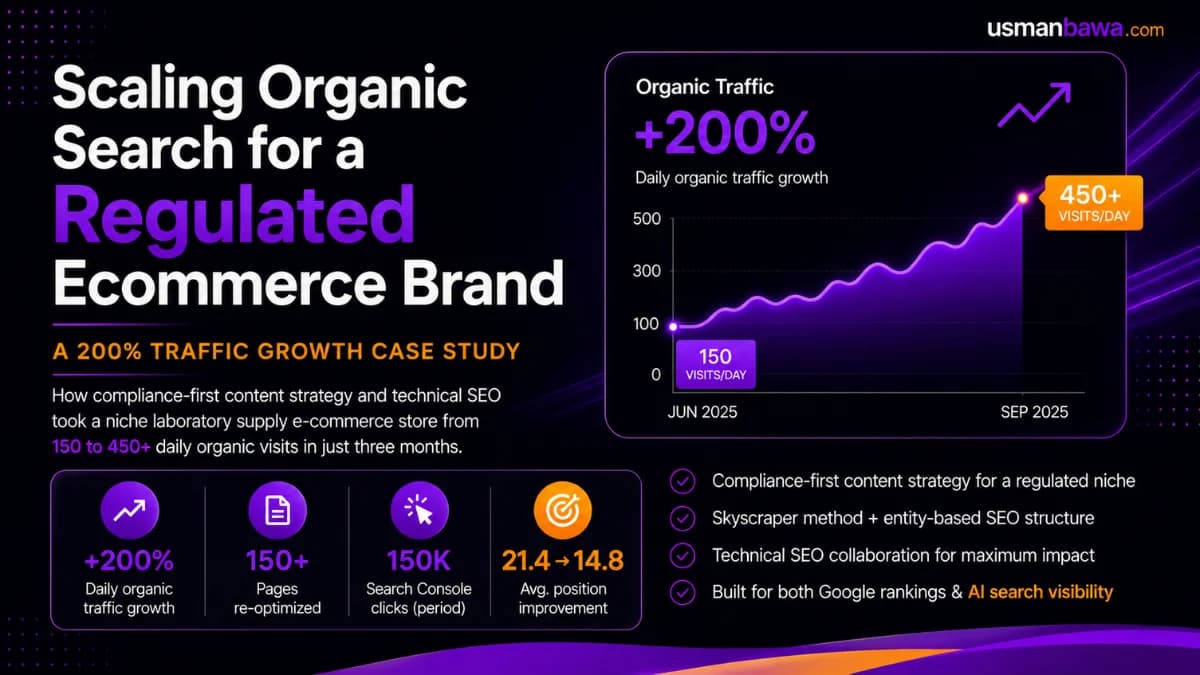
How compliance first content strategy and technical SEO took a niche laboratory supply e-commerce store from 150 to 450+ daily organic visits in three months.
| +200%
Daily organic traffic growth |
150+
Pages re-optimized |
150K
Search Console clicks (period) |
21.4 → 14.8
Avg. position improvement |
Project Snapshot
| Industry | Ecommerce, laboratory research supplies & analytical compounds (WooCommerce) |
| My role | SEO Strategist & Content Writer (ongoing, 12+ months) |
| Core focus | Content strategy, keyword research, on-page/metadata rewrites, compliance safe copywriting, editorial planning, topical authority building |
| Collaborators | Technical SEO and web development functions handled the crawl, indexation, and site-performance remediation in parallel |
| Key constraint | All product and content copy had to comply with strict industry labeling rules, every compound described strictly as a research/laboratory material, with no language implying human use |
The Brief
The client, an established ecommerce retailer selling laboratory research compounds, peptides, and analytical reagents came in with a large product catalogue and a storefront that had plateaued at roughly 150 organic visits a day. My mandate as SEO Strategist and Content Writer was to rebuild the site’s search visibility from the ground up: keyword research, on-page optimization, and an entirely new content and editorial program, working alongside the technical and development side of the engagement, which handled crawl, indexation, and page-speed remediation.
The brief carried an unusual complication. This is a heavily regulated niche in which every product had to be positioned and described strictly as a research or laboratory compound, and copy could never suggest, imply, or reference human consumption or use. That constraint touched every deliverable, product descriptions, category copy, meta titles, and every article on the new blog and it shaped how I approached keyword selection and content briefs from day one.
The Starting Point
The scale of the problem was clear before any content strategy could begin. My technical audit found a site that looked healthy on desktop but was badly broken on mobile and mobile is what Google actually crawls and ranks on. A 19.2 second Largest Contentful Paint against a 2.5 second target isn’t a tuning issue, it’s a rendering failure, and it meant the site was fighting an uphill battle before a single word of new content went live.
Table 1. Core Web Vitals and supporting lab metrics, mobile in June 2025
| Metric | June 2025 (mobile) | Google’s “good” threshold | Assessment |
| First Contentful Paint | 7.2 s | Under 1.8 s | Poor |
| Largest Contentful Paint | 19.2 s | Under 2.5 s | Critical |
| Total Blocking Time | 410 ms | Under 200 ms | Needs work |
| Cumulative Layout Shift | 0.174 | Under 0.1 | Needs work |
| Speed Index | 10.6 s | Under 3.4 s | Slow |
Table 2. The same metrics on desktop June 2025
| Metric | June 2025 (desktop) | Google’s “good” threshold | Assessment |
|---|---|---|---|
| First Contentful Paint | 1.3 s | Under 1.8 s | Good |
| Largest Contentful Paint | 1.5 s | Under 2.5 s | Good |
| Total Blocking Time | 330 ms | Under 200 ms | Slightly high |
| Cumulative Layout Shift | 0.002 | Under 0.1 | Good |
| Speed Index | 2.5 s | Under 3.4 s | Good |
Mobile rendering was only half the problem. Our indexation audit turned up 1,976 URLs sitting outside Google’s index entirely, meaning nearly two thousand pages had no chance of ever ranking regardless of how good the content on them was. Not all of these were defects (some robots.txt exclusions are intentional, like cart and checkout pages), but a meaningful share, 418 pages crawled and rejected, 346 dead redirects, 78 broken URLs showed real structural waste. Publishing new content into that environment would have added cost without adding visibility, which is why fixing the foundation had to come before the content program began.

Table 3. Index coverage at the start of the engagement
| Reason pages were not indexed | Pages |
| Blocked by robots.txt | 1,044 |
| Crawled – currently not indexed | 418 |
| Page with redirect | 346 |
| Not found (404) | 78 |
| Excluded by no-index tag | 36 |
| Alternate page with proper canonical tag | 30 |
| Discovered – currently not indexed | 12 |
| Other (403, soft 404, and similar) | 12 |
| Total | 1,976 |
The Challenge: Content Trust in a Zero Room for Error Niche
Before this engagement, the client had no blog at all. He had avoided commissioning one for a long time, having previously worked with writers who couldn’t reliably keep consumption of adjacent language out of the copy, a real risk in this category, where a single careless line can create a compliance problem. That history made him cautious about handing content over to anyone new.
Part of my job in the first weeks wasn’t just writing but it was also proving the content could be both compliant and genuinely useful to the site’s audience of researchers and lab buyers. I built the first batch of articles around strict internal guidelines. Every compound was treated purely as a research subject, every claim framed around laboratory properties, identification, handling, and third-party purity documentation rather than any application.
Once the client reviewed the initial drafts, he approved the blog for launch, something he’d held off on for years and it became one of the most productive parts of the engagement.
Strategy & Execution
Reading the Competitive Landscape First
Before writing a single brief, I mapped the competitive set to understand where organic demand in this category actually sat. Five direct competitors dominated the shared keyword space, and the positioning map made the opportunity clear. These weren’t stronger domains, several carried similar or even lower authority.
The gap was coverage. They ranked for more because they’d published more pages addressing more queries, with internal structures that let those pages reinforce each other. That reframed the brief, this wasn’t a market where we needed to out-muscle one entrenched leader, it was one where a much larger keyword footprint was sitting unaddressed, and better organized content could take share across the long tail.

Keyword Research Rooted in Real Demand
Rather than relying purely on third party keyword tools, I cross referenced Google Search Console’s existing impression data against Semrush and Ahrefs research to find queries the site was already marginally visible for, the fastest wins available, since they needed improvement rather than a cold start. This surfaced category level terms, compound specific product queries, comparison and specification searches, and long-tail research intent phrases that mapped directly onto the catalogue.
Metadata Rebuild Across 150+ Pages
I rewrote SEO titles and meta descriptions across the homepage, every category page, and the full commercial product set over 150 pages in total. Each page was assigned a single primary query and written to earn the click, not just to satisfy a checklist, surfacing certificate of analysis verification, purity documentation, and shipping details, since buyer trust is the deciding factor in this category more than in most ecommerce niches.
A Compliance First Editorial Program, Built Using the Skyscraper Method
Every article was commissioned against a specific keyword cluster with a defined link back to a commercial page, not against a generic content calendar. For each target topic, I used the skyscraper approach which is analyzing the highest ranking existing content for that query, identifying what it left out like missing specifications, thin sourcing, no analytical or handling detail and then briefing or writing a more comprehensive, better structured, and more rigorously sourced replacement, anchored in the client’s own certificate of analysis library.
- Compound overview and identification pages
- Comparison and specification content
- Laboratory application and handling notes, framed strictly around research use
- Storage, handling, and safety documentation
- Property and analytical reference content
Every article linked deliberately back into the category and product pages it supported, so newly earned informational relevance had a direct path into commercial pages, and the internal link graph did real navigational work rather than sitting there as decoration.
Building for AI and Answer Engine Visibility
Alongside traditional ranking factors, I structured content to perform in AI driven and answer engine search. Clear entity based headings, direct definitional answers near the top of each article, comparison tables, and consistent terminology so that compound names, properties, and specifications could be reliably parsed, extracted, and cited by generative search systems as well as by traditional crawlers. That groundwork is now feeding into the client’s move toward a full hub and cluster “Research Hub” architecture, comprehensive authority pages per compound, with supporting articles clustered and linked inward which is designed to keep working even as more of the commercial catalogue moves behind gated account access for compliance reasons.
Results
Within the first three months of the engagement, the combined effect of the technical remediation, the metadata rebuild, and the new content program was visible in Search Console:
- Average daily organic traffic grew from ~150 to 450+ visits, an increase of more than 200%
- Average keyword position improved from 21.4 to 14.8 (from the bottom of page two into the lower half of page one)
- Impressions and clicks both rose substantially as the site became eligible for a far wider set of queries
- 150+ pages of metadata rewritten, resolving keyword cannibalisation across product and blog content
- A previously nonexistent blog became a sustained, compliant content channel and a foundation for the client’s ongoing content strategy
The Search Console data tells the same story with more granularity. At the start of the engagement, the property was pulling 5.3K total clicks and 63.6K impressions at an average position of 21.4. By the most recent reporting period, that had grown to 150K clicks and 2.16M impressions, with average position improving to 14.8, a five fold plus increase in impressions and roughly 28x growth in clicks over the engagement.


Over the following year, the domain’s footprint continued to expand, organic keyword count and referring domains grew together rather than traffic resting on a narrow set of terms, and the site began appearing in early AI search citations, a metric now being grown deliberately as part of the Research Hub phase.
Where the Domain Stands Today
Third-party tracking now shows an Authority Score of 24, roughly 976 organic keywords, 349 referring domains, and 1.8K total backlinks, keyword coverage and referring domains growing together rather than traffic resting on a narrow set of terms, which is the healthier growth pattern.
The domain is also beginning to show up in AI-search visibility tracking, with early citations across ChatGPT, Google AI Overview, AI Mode, and Gemini, a small footprint today, but one that validates the entity based, answer engine ready content structure built during the engagement, and a metric now being grown deliberately as the Research Hub phase continues.

What This Project Demonstrates
- Writing high volume and search optimized content inside strict legal and compliance constraints, without losing quality or usefulness
- Earning a skeptical, previously burned client’s trust in outsourced content and turning that into a long term, 12 month plus retainer
- Keyword and content strategy built on real Search Console demand data, not just tool estimates
- Applying the skyscraper content method systematically across an entire editorial calendar, not as a one-off tactic
- Structuring content for both classic SEO and emerging AI/answer-engine (GEO) visibility
- Coordinating content strategy with a parallel technical SEO and development workstream on a single engagement
Client Relationship
This engagement has run for more than a year and continues today. What began as a single content and SEO project has expanded into an ongoing content strategy partnership, including the client’s current shift toward a research-hub content architecture, a direct result of the trust built in the first few months of compliant and high quality content delivery.
Want Similar Search Results?
Let's discuss how we can audit your technical foundation, eliminate indexation bottlenecks, and scale your organic visibility.
- Technical Crawl & Speed Audit
- Compliance Content Strategy
- Generative Search (GEO) Plan